
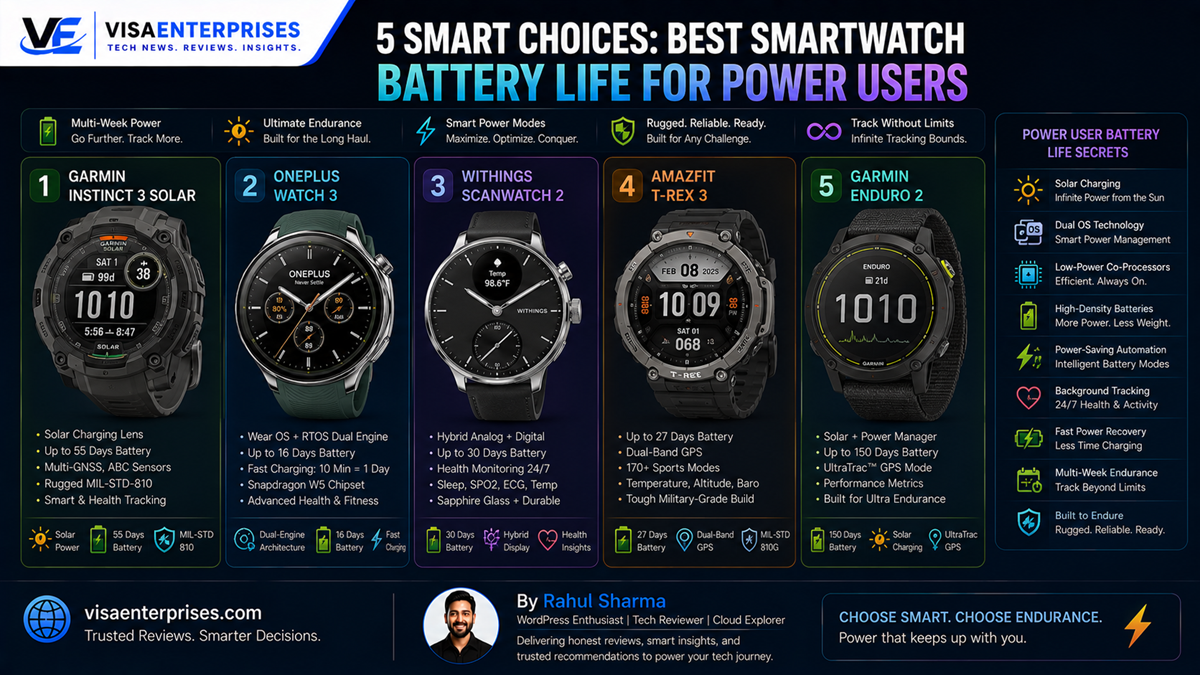
The best smartwatch battery life is achieved by stepping away from standard, high-drain daily chargers and moving toward specialized display hardware and multi-engine processing. For the absolute peak of off-grid tracking, the Garmin Instinct 3 Solar stands out by offering literal infinite battery life in standard smartwatch mode when exposed to three hours of daily sunlight. For a full-featured Wear OS experience that doesn’t sacrifice cellular capability, the OnePlus Watch 3 leads its class with a unique dual-chipset framework that stretches battery endurance to a solid four to six days on a single charge.
Introduction
The mainstream wearable industry has conditioned consumers to accept a frustrating daily chore: the evening charging routine. Elite flagship devices from dominant smartphone ecosystems offer gorgeous high-resolution screens, exhaustive application catalogs, and local voice assistant features, but their internal architectures are highly power-hungry. Most of these full-scale devices run completely dry within 18 to 36 hours of leaving a charging dock, forcing users to constantly manage low-battery warnings.
That standard framework is completely unnecessary if you prioritize endurance. A distinct class of high-performance wearables challenges this daily dependency.
By choosing a device engineered specifically around the best smartwatch battery life, you shift your tracking capabilities from hours to weeks—and in some specialized setups, completely infinite bounds. Whether your routine centers on extreme high-altitude expeditions, long fitness training tracking, or clean executive style with background health logging, finding an optimized companion that handles weeks of continuous wear is entirely achievable. This guide analyzes five top contenders reshaping battery expectations right now.
The Technology Behind Ultra-Endurance Wearables
Achieving the best smartwatch battery life involves more than simply packing a larger, heavier battery cell beneath the rear casing. It requires a fundamental shift in how display hardware handles light output and how internal system chips process background calculations.
[Full Mainstream Smartwatch]  ──> High-Nit AMOLED Screen ──> Single OS Processor ──> 1-2 Days Max
[Endurance-First Wearable]   ──> Memory-in-Pixel Display ──> Dual-Engine Coprocessor ──> Multi-Week Ramping
1. Memory-in-Pixel (MIP) vs. AMOLED Power Ratios
Standard smartwatches use bright AMOLED display glass that requires continuous electrical currents to illuminate every pixel. Conversely, ultra-endurance devices utilize Memory-in-Pixel (MIP) display layers. MIP screens reflect ambient environmental light natively, meaning the brighter the outdoor sunlight, the clearer the screen appears without drawing a single milliamp of system power for a backlight.
2. Dual-Engine Chip Architectures
Devices like the OnePlus Watch 3 catch up to Wear OS competitors without inheriting their rapid power draw by adopting a smart dual-engine architecture. The watch houses two distinct processors running different operating systems simultaneously. A high-power application chip wakes up briefly to render complex Wear OS apps, while a low-power coprocessor handles background heart rate tracking and steps logs invisibly on an efficient real-time operating system (RTOS).
Top 5 Smartwatches with the Best Battery Life
Navigating the endurance market requires aligning your tracking needs with a specific design philosophy. The top choices on the market right now split cleanly between ultra-rugged outdoor toolsets, full-featured smart platforms, and elegant hybrid unibody builds.
1. Garmin Instinct 3 Solar: The Perpetual Off-Grid Standard
Garmin continues to dominate the absolute peak of extreme tracking endurance. The Instinct 3 Solar drops high-drain touch screens completely, relying instead on a high-contrast two-window MIP screen paired with a highly advanced photovoltaic lens.
When exposed to standard outdoor light conditions, it converts environmental solar energy into system power so efficiently that it achieves unlimited battery life in smartwatch mode, making it an unrivaled choice for long wilderness treks.
2. OnePlus Watch 3: The Wear OS Endurance Leader
For users who refuse to trade away full Google app access, interactive maps, or rich notifications, OnePlus provides the ultimate compromise. By pairing its dual-chipset framework with a high-capacity battery layer, it delivers an epic 4 to 6 days of true smart connectivity.
The front of the chassis sports a gorgeous 1.5-inch LTPO AMOLED screen that uses advanced dimming controls to minimize eye strain and battery draw simultaneously.
3. Withings ScanWatch 2: The Elegant Hybrid Milestone
If your daily aesthetic leans toward classic luxury timepieces rather than bulky plastic sports gear, Withings offers a stunning solution. The ScanWatch 2 looks like a traditional mechanical watch, complete with physical analog hands and a premium sapphire glass face.
Hidden inside the dial is an ultra-efficient grayscale OLED window that displays vital notifications and tracking results, helping the device deliver a remarkable 30 days of medical-grade wellness monitoring on a single charge.
Step-by-Step Optimization for Extended Battery Lifespans
To push your wearable’s power reserves past factory estimates and ensure your tracking suite runs efficiently during long travel blocks, configure these key preferences within your settings.
1. Configure Dynamic Screen Activation Paths
Ensure your display layer does not consume power unnecessarily during random arm movements throughout the day.
- Open your watch’s core Settings menu and navigate to Display / Gestures.
- Locate the Always-On Display (AOD) preference row and toggle it Off.
- Select the Raise-to-Wake / Gesture Activation sub-menu and change the behavior to Touch Screen Only or map a shorter 5-second timeout window.
- This simple adjustment keeps the main screen dark until you explicitly prompt it, adding days to your battery tracking window.
2. Adjust Background Biometric Sensor Sweeps
Manage your continuous health sensing grids to balance detailed health tracking with smart energy conservation.
- Enter your watch companion application on your paired smartphone.
- Navigate to the health tracking configurations panel and select Blood Oxygen (SpO2) Monitoring.
- Change the tracking frequency from continuous background scanning over to Sleep Tracking Only or manual on-demand checks.
- Note: Continuous SpO2 tracking uses significant battery power due to the optical LEDs running continuously; restricting it to overnight use can instantly boost your battery life.
3. Initialize Location Service Triangulation Rules
Set your satellite modems to use efficient positioning paths rather than straining your power limits on maximum hardware loops.
- Launch the workout configurations menu directly on your watch screen before starting a route.
- Open the GPS / Positioning Settings directory.
- Switch the tracking profile from Multi-Band / All-Systems over to GPS Only or Smart/Intelligent Tracking Mode.
- This adjustment reduces battery draw during outdoor workouts, allowing devices like the Amazfit T-Rex 3 to continuously trace trails for hours without a charge.
Common Mistakes to Avoid with Endurance Wearables
Achieving the peak numbers highlighted in the best smartwatch battery life metrics requires avoiding a few common user configuration and charging errors.
Leaving Continuous LTE Cellular Connection Searching Active
Purchasing a cellular-enabled wearable and leaving independent LTE data tracking turned on while traveling through remote areas with poor network coverage will drain your power reserves rapidly. The watch modems will crank up their transmission voltages to search for a signal, which can drain a full charge in roughly 4 to 5 hours. To protect your battery life, always turn off standalone cellular options when your phone is nearby or when moving through weak coverage zones.
Using High-Contrast Third-Party Animated Watch Faces
Installing unoptimized watch faces from digital application storefronts that feature full-screen bright white backgrounds, live weather graphics, or complex custom animations will bypass your device’s native low-power refresh optimizations. These custom face layouts keep the main processing cores active, which can cause unexpected midday battery drain. Stick to clean, dark-themed watch faces to minimize active display draw.
Neglecting Regular Cleanings of Solar Charging Glass Panels
For solar-assisted tracking devices like the Garmin Instinct or Fenix lines, allowing heavy layers of sunscreen, dried sweat, salt water deposits, or mud to remain on the watch face will block light from reaching the underlying solar cells. This skin layer significantly lowers your solar charging efficiency, preventing the device from achieving its unlimited battery runtime potential. Always wipe your watch face clean with a damp microfiber cloth after intense outdoor activities.
Long Battery Life Smartwatch Comparison Table
The comparison matrix below highlights the direct performance benchmarks across the top endurance wearables available right now.
| Endurance Smartwatch Model | Smartwatch Mode Lifespan | Maximum Battery Saver | Continuous GPS Tracking | Installed Screen Technology |
| Garmin Instinct 3 Solar | Up to Unlimited (Solar) | Perpetual Standby State | 60 to 145 Hours (Solar) | 1.1-Inch Two-Window MIP |
| OnePlus Watch 3 | 3 to 5 Days (Wear OS) | Up to 16 Days Total | Up to 40 Hours Dual-Band | 1.5-Inch LTPO AMOLED |
| Withings ScanWatch 2 | Up to 30 Days Natively | N/A (Fixed Profile) | Connected Phone GPS Only | 0.63-Inch Grayscale OLED |
| Amazfit T-Rex 3 | Up to 21 Days Typical | Up to 50 Days Total | Up to 80 Hours Continuous | 1.5-Inch High-Bright AMOLED |
| Garmin Enduro 2 | Up to 34 Days Natively | Up to 46 Days with Solar | Up to 150 Hours with Solar | 1.4-Inch Transflective MIP |
Pros and Cons of Long-Life Smartwatches
Pros
- Freedom from Daily Charging: Multi-week power lifespans completely eliminate the hassle of packing chargers for short trips or weekend getaways.
- Continuous Health Tracking: Extended battery life allows for true, uninterrupted sleep coaching, readiness tracking, and recovery scoring.
- Exceptional Outdoor Visibility: Reflective MIP and hybrid display panels get sharper and easier to read under direct, bright outdoor sunlight.
- Highly Rugged Build Quality: Endurance-focused casings feature premium, military-grade materials engineered to withstand severe drops and extreme weather shocks.
Cons
- Fewer Third-Party Smart Apps: Ultra-long battery options often pass up heavy full-scale application storefronts to keep their system codes lightweight.
- Thicker Wrist Dimensions: Housing dense, high-capacity cells and solar layers usually results in a bulkier frame profile that may feel heavy on smaller wrists.
Frequently Asked Questions
Which wearable delivers the absolute best smartwatch battery life?
The Garmin Instinct 3 Solar claims the top crown, leveraging its hyper-efficient MIP display and advanced solar charging glass to deliver unlimited battery life in standard smartwatch mode.
How does the OnePlus Watch 3 last so long while running Wear OS?
It utilizes an innovative dual-engine chip design that handles routine background health tracking on a low-power coprocessor, keeping the main power-heavy Android chip completely asleep until you launch full apps.
Do long-life smartwatches compromise on health and fitness metrics?
No. Top models pack comprehensive sensor arrays, delivering medical-grade health monitoring, blood oxygen metrics, deep sleep analysis, and advanced sports training analytics that rival standard short-lived smartwatches.
Can solar-powered smartwatches recharge fully from indoor room lights?
No. The solar charging glass panels are tuned specifically to harvest high-lux outdoor sunlight. While fluorescent or LED office lights can provide a trace assist, achieving perpetual battery runtime requires exposure to direct outdoor light.
Why do mainstream smartwatches have such short battery runtimes?
Full-scale watches favor vibrant, high-refresh AMOLED screens, constant cellular connections, and heavy background app synchronizations, which demand far more continuous power than hybrid or MIP displays.
Can I respond to incoming phone notifications on a hybrid watch?
Yes. Hybrid options like the Withings ScanWatch 2 display quick text summaries on their compact digital screens and support basic pre-set replies, though they omit full on-wrist typing keypads to save space.
What is the advantage of dual-frequency GPS tracking?
Dual-frequency GPS receives location data across two separate satellite bands (L1 and L5) simultaneously, which helps prevent location drift and ensures accurate route mapping around tall city skyscrapers or deep canyon walls.
How does using the Always-On Display impact total battery life?
Keeping the Always-On Display active can slice your total battery life in half on AMOLED devices because it forces the screen pixels to stay constantly illuminated, even when you aren’t looking at the watch.
Are long-life smartwatches fully water resistant for swimming?
Yes. Most high-end endurance wearables feature robust 5 ATM or 10 ATM pressure ratings, certifying they can easily handle open-water swimming, pool training laps, and deep diving exploration safely.
What charger is required to take full advantage of fast power recovery?
To quickly charge your device back to full strength, connect the included magnetic charging dock to a certified USB-C Power Delivery wall adapter, which can often restore a week’s worth of power in just 15 to 20 minutes.
Final Verdict
Investing in a wearable built for the best smartwatch battery life frees you from the constant anxiety of a dying screen and the hassle of a daily charging routine. By selecting mature architectures that successfully combine transflective display layers, solar charging capability, and smart dual-engine processors, you can enjoy a powerful tracking companion tailored to any adventure.
For the absolute pinnacle of off-grid endurance that frees you from power cords entirely, choose the exceptional Garmin Instinct 3 Solar. If you want a full-featured smart workspace with deep app connectivity and multi-day battery life, opt for the intelligent OnePlus Watch 3. Whichever model lines up with your daily style, stepping up to an endurance-first wearable provides a spacious, reliable digital tracking experience that will easily go the distance.
Technical Resources and References
Internal Links
For a deeper dive into our architectural components, view our related breakdowns:
External References
Review official test reviews and technical platform metrics directly from trusted wearable authorities:
- Android Central Best Endurance Lists: https://www.androidcentral.com/wearables/best-smartwatches-for-battery-life
- Garmin Developer Solar Network Notes: https://developer.garmin.com/open-source/instinct-3-specs/
- PCMag Comprehensive Wearable Reviews: https://www.pcmag.com/picks/the-best-smartwatches

- 5 Smart Ecosystems: Best Smart Home Devices for Seamless Flow - June 2, 2026
- 10 Smart Choices: Top AI Productivity Tools for Workday Success - June 2, 2026
- 5 Smart Choices: Best Budget Smartwatch Models for Hitting Goals - June 2, 2026