
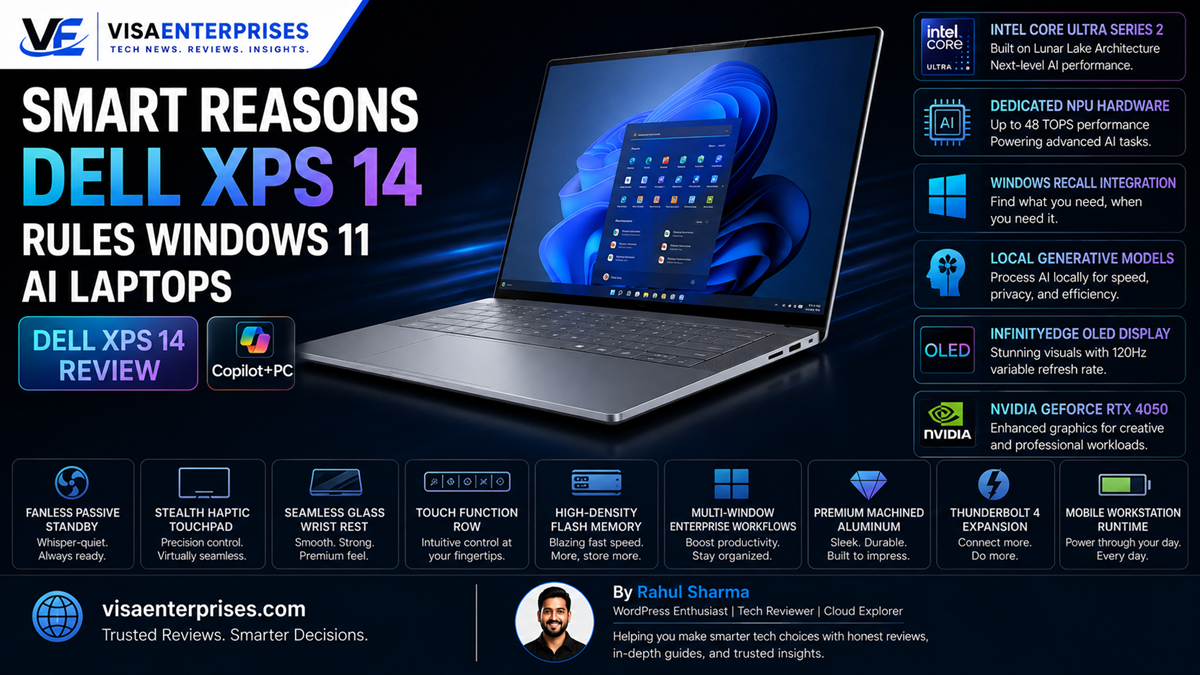
The Dell XPS 14 has officially claimed the premium throne among Windows 11 AI laptops by successfully pairing high-end design with next-generation local computing hardware. Driven by the latest Intel Core Ultra processors featuring an integrated Neural Processing Unit (NPU) capable of delivering over 40 TOPS (Trillion Operations Per Second), this machine effortlessly fulfills Microsoft’s strict Copilot+ PC operational requirements. Equipped with a stunning 3.2K InfinityEdge OLED display, a seamless glass haptic trackpad, and an optional NVIDIA RTX 4050 graphics core, the Dell XPS 14 provides a smooth, whisper-quiet mobile workspace that marks a major milestone for Windows 11 AI laptops.
Introduction
The premium notebook landscape is undergoing its most radical transformation since the transition away from spinning mechanical hard drives. For nearly a generation, evaluating a portable computer was a simple matter of comparing raw clock speeds, checking available storage volumes, and measuring total battery capacities. If a machine scrolled smoothly and rendered web pages quickly, it was considered a successful configuration.
The arrival of advanced neural computing layers has completely disrupted that traditional roadmap. Today, elite business laptops are expected to process complex context clues, manage local data models, and automate intricate background tasks without generating excessive heat or constantly phoning home to cloud data centers.
As major manufacturers roll out their latest hardware fleets, a clear elite tier has emerged within the universe of Windows 11 AI laptops.
By conducting a rigorous, real-world evaluation of the updated Dell XPS 14, we analyze whether this bold structural rethink justifies its luxury investment point. From physical design changes and hidden touchpad mechanics to local machine learning workflows and thermal dissipation curves, we break down exactly how this device performs under demanding corporate conditions.
The AI Silicon Revolution: Intel Lunar Lake and Copilot+
To truly understand why the Dell XPS 14 sits at the front of the pack among modern Windows 11 AI laptops, you have to look beneath its sleek aluminum casing. Previous attempts at adding intelligence layers to portable computers felt clunky; they were essentially standard processing chips running heavy cloud-dependent software scripts that created severe interface lag and rapidly drained battery cells.
The latest wave of Windows 11 AI laptops eliminates these bottlenecks by integrating a dedicated, hardware-level computing engine straight into the silicon die.
[User Automation Intent] ──> [Intel Core Ultra Core Allocation] ──> [Hardware NPU Matrix (>40 TOPS)]
                                                                               │
[Instant Silent Local Output] <── [Intelligent Dual Fan Cooling] <── [Shared Low-Latency RAM]
Unpacking the TOPS Performance Boundary
The updated Dell XPS 14 shifts its engine architecture to the latest Intel Core Ultra platforms. This custom system layout contains a highly specialized Neural Processing Unit engineered specifically to handle repetitive, complex matrix mathematics.
By pushing past the critical 40 TOPS benchmark, the laptop processes language inputs, automated code tracking blocks, and real-world audio transcription files entirely on-device, cutting out the data delays and privacy concerns of cloud-based servers.
Contextual OS Features Natively Handled
This localized processing power enables a suite of smart operating system tools that run continuously in the background of premium Windows 11 AI laptops:
- Cocreator in Paint: Translates rough, freehand mouse or stylus sketches into highly polished digital artwork and diagrams in real time based on simple text prompts.
- Live Captions with Translation: Automatically intercepts any active audio stream across the system—whether it’s an uncaptioned video file, a live web call, or a local media file—and outputs English text subtitles on screen instantly from over 40 distinct global languages.
- Windows Studio Effects: Utilizes advanced background algorithms to manage camera tracking, automatically framing your face, filtering out ambient room noise, and maintaining artificial eye contact during corporate calls.
Futuristic Hardware Design and Touchpad Architecture
While the internal silicon architecture sets a high standard for Windows 11 AI laptops, the physical chassis of the Dell XPS 14 represents an equally radical departure from standard computing layouts. Dell rejects the traditional look of plastic keys and separate mechanical trackpad frames, opting instead for a highly polished, unified block of CNC machined aluminum and protective Gorilla Glass 3.
The Illusion of the Seamless Glass Wrist Rest
Opening the laptop display reveals a completely smooth glass surface stretching across the entire lower deck. There are no physical seams, cutouts, or painted borders to indicate where the trackpad begins or ends:
- Hidden Haptic Technology: The trackpad is completely invisible, built straight into the central glass layer. It relies on a matrix of precise linear resonant actuators to simulate the tactile feel of a physical click using software-controlled vibrations.
- Ergonomic Typing Fields: Surrounding the hidden touchpad is a spacious wrist rest that stays comfortably cool to the touch even during heavy data entry blocks.
- Responsive Control Mapping: The system tracking software reads finger movements instantly, filtering out accidental palm rests when typing out long documents.
The Cap-Sense Function Row and Lattice-Free Keyboard
Directly above the main keyboard row sits a glossy touch-sensitive glass bar that replaces traditional physical function and escape keys. This capacitive strip switches back and forth between standard F-key controls and media adjustments based on your active system state.
Below it, the keys utilize a unique “zero-lattice” design, removing the traditional plastic gaps between individual keycaps to maximize surface area and deliver an exceptionally stable, low-travel typing experience.
Step-by-Step Optimization for Windows 11 AI Laptops
To maximize the processing speed, local automation responsiveness, and overall battery health of your Dell XPS 14, configure these essential system adjustments across your Windows 11 settings interface.
1. Optimize Local NPU Resource Priorities
Ensure your operating system allocates its dedicated silicon hardware efficiently to keep background automation tools completely responsive.
- Click the Start button and launch your core Settings application.
- Navigate into the System column and select the Privacy & Security configuration options.
- Scroll down to locate the Generative AI & Local Model Permissions row.
- Move the processing priority slider over to Maximize Local Hardware Allocation to allow the system NPU to keep essential text and context files permanently loaded in system memory.
2. Configure Dynamic Display Refresh Ranging
Set your premium InfinityEdge OLED screen to balance bright, fluid visual rendering with intelligent battery conservation.
- Open your core Settings panel and select the System tab.
- Click into the Display choices and open the Advanced Display sub-menu.
- Locate the Choose a refresh rate selection matrix.
- Change the dropdown choice from a fixed frequency over to Dynamic (60Hz / 120Hz) to let the panel automatically drop down during text editing blocks and climb back up during fast interface transitions.
3. Initialize Advanced Copilot Key Shortcuts
Map your physical hardware input shortcuts to access local assistance workflows instantly.
- Tap the dedicated physical Copilot Key located on the lower right quadrant of your keyboard assembly.
- When the side configuration window slides out, tap the top-right options wheel.
- Select Local Mode Defaults to configure the engine to process quick formatting, folder lookups, and system summaries locally on your chip without sending requests across the network.
4. Activate Intelligent Battery Preservation Protocols
Enable smart system power routing to protect the long-term chemical lifespan of your high-density internal battery cell.
- Launch the pre-installed Dell Command | Power Manager configuration dashboard.
- Click into the Battery Health and Charging Profiles options directory.
- Change your charging rule from Standard over to Primarily AC Use if your laptop spends long stretches connected to a desktop dock. This configuration lowers thermal stress by holding the maximum charge at a stable, safe 80% threshold.
Common Mistakes to Avoid with High-End Windows Laptops
Getting the absolute best long-term value out of premium Windows 11 AI laptops requires making informed equipment configurations at checkout and avoiding common operational slip-ups.
Opting for Baseline Storage Configurations on Advanced AI Setups
Choosing a restricted 512GB baseline internal flash drive on high-performance Windows 11 AI laptops can quickly lead to space constraints down the road. Local language models, transcription dictionaries, and advanced image generation caches require massive amounts of local space to run offline. Always prioritize configuring a minimum 1TB or 2TB high-speed NVMe SSD drive to ensure your local automation tools have plenty of room to expand.
Straining the Fanless Passive Standby States in Soft Cases
The Dell XPS 14 utilizes an exceptionally advanced passive standby state that lowers core processing speeds to zero when you close the screen lid. However, if an application process hangs background tasks open or ignores sleep commands while the machine is packed inside a tight neoprene travel sleeve, the dual internal fans will fail to draw fresh air. Always confirm that your system status indicator light is fully dark before packing your laptop into a soft travel bag.
Using Cheap Low-Wattage Universal Power Adapters
The laptop introduces faster charging curves capable of pulling up to 100W of power over standard USB-C lines, especially when configured with the optional NVIDIA RTX 4050 graphics card. Attempting to charge the device using a cheap, low-wattage smartphone block or an old legacy laptop cable will result in slow charging speeds or cause the battery to slowly drain even while plugged in. Always connect your machine to a certified Power Delivery (PD 3.0) wall brick rated for a flat 100W output.
Premium Windows AI Laptop Comparison Matrix
The data table below highlights how the Dell XPS 14 stacks up against competing premium options within the current universe of Windows 11 AI laptops.
| Architectural Feature | Baseline Business Notebooks | Ultraportable AI Options | Dell XPS 14 Flagship Model |
| Processor Platform | Intel Core Ultra Gen 1 | Qualcomm Snapdragon X Elite | Intel Core Ultra Series 2 (Lunar Lake) |
| NPU Computing Bandwidth | ~11 to 34 TOPS | Up to 45 TOPS (Arm Base) | Over 40 TOPS Natively (x86 Base) |
| Primary Display Tech | Standard 60Hz IPS LCD | 90Hz Touchscreen AMOLED | 3.2K InfinityEdge 120Hz OLED |
| Trackpad Assembly Layout | Traditional Mechanical Frame | Standard Glass Haptic Border | Seamless Invisible Haptic Glass |
| Discrete Graphics Options | Integrated Graphics Only | Qualcomm Adreno Solution | NVIDIA GeForce RTX 4050 Core |
| Baseline System Memory | 8GB to 16GB Standard | 16GB Fixed Allocation | 16GB to 64GB LPDDR5X (Dual Channel) |
| Starting Investment Ranging | Retails from ~$999 | Retails from ~$1,299 | Retails from $1,499 / ₹1,64,990 |
Pros and Cons of the New King of Windows Laptops
Pros
- Superb Local AI Performance: The high-speed NPU processes language translation and contextual indexing tasks instantly without using cloud data networks.
- Breathtaking InfinityEdge Screen: The 3.2K 120Hz OLED display panel outputs incredible contrast levels, making it fantastic for precision creative work.
- Striking Minimalist Aesthetics: The seamless glass unibody deck and invisible haptic trackpad deliver a beautiful, modern design footprint.
- Excellent Graphics Flexibility: Offering an optional discrete NVIDIA RTX 4050 card lets this thin laptop easily handle video editing and light gaming blocks.
- Future-Proof Software Base: Full compliance with Microsoft’s Copilot+ ecosystem ensures access to advanced operating system features for years to come.
Cons
- Capacitive Row Learning Curve: The touch-sensitive function keys require some getting used to compared to traditional physical buttons.
- Luxury Entry Pricing: The premium build materials and high-end components require a significant upfront financial commitment.
Frequently Asked Questions
What makes the Dell XPS 14 stand out among Windows 11 AI laptops?
The laptop leads the category of Windows 11 AI laptops by combining an elite, minimalist unibody chassis with a high-speed NPU that clears the 40 TOPS threshold required to process complex generative tasks completely on-device.
How does the invisible haptic trackpad function on this model?
There are no physical cutouts or moving borders on the lower deck. The trackpad is embedded directly beneath a seamless sheet of Gorilla Glass, using advanced linear actuators to mimic the feel of a physical click.
Can the Dell XPS 14 run advanced AI features completely offline?
Yes. Thanks to its hardware-level NPU engine, the system processes advanced language translation, audio transcription, and image generation tools locally without requiring an active internet connection.
What are the main benefits of the 3.2K InfinityEdge OLED display?
The premium OLED display panel delivers deep, infinite contrast ratios, covers 100% of the DCI-P3 color space for color-accurate creative work, and features a smooth 120Hz dynamic refresh rate.
What type of wall charger is required to unlock fast charging?
To take full advantage of rapid power recovery and keep the machine charged during intense processing workloads, you need to use a certified USB-C Power Delivery adapter that outputs a minimum of 100W.
Is the system memory upgradable after purchasing the laptop?
No. To maximize data transfer speeds and achieve a slim chassis layout, the high-performance LPDDR5X system memory is soldered directly onto the main motherboard, meaning you should choose your memory tier carefully at checkout.
Does the capacitive touch function row support haptic feedback?
No. The top cap-sense function strip lights up clearly and responds instantly to light finger taps, but it does not include localized vibration feedback when clicked.
How many external monitors can the Dell XPS 14 drive simultaneously?
Equipped with high-speed Thunderbolt 4 infrastructure, the laptop’s display engine can easily drive two external 4K monitors at 60Hz simultaneously alongside the main built-in screen.
What is the typical battery runtime of the device during standard workdays?
For standard office productivity tasks—like editing sheets, answering emails, and browsing webs—the high-density battery cell easily delivers 11 to 14 hours of continuous usage.
Does the Dell XPS 14 feature a dedicated physical Copilot key?
Yes. Following modern design standards for elite Windows 11 AI laptops, the keyboard assembly integrates a dedicated physical button on the lower right row to summon your AI assistant instantly.
Final Verdict
The launch of the Dell XPS 14 establishes a bold new standard for premium Windows 11 AI laptops. By moving past traditional, disjointed design choices and embracing a seamless glass unibody layout, Dell has created a machine that feels like a true piece of future technology. Under the hood, the combination of Intel’s high-speed Lunar Lake processor and a dedicated, local NPU ensures that power users can tap into advanced automation tools without sacrificing battery life or dealing with loud fan noise.
While the luxury pricing and capacitive function bar require a slight adjustment from legacy users, the massive jump in localized processing power and exceptional build quality make it a stellar investment. For any executive, software engineer, or creative professional looking for a secure, future-proof laptop that effortlessly balances processing muscle with stunning design, the Dell XPS 14 is the definitive king of the modern Windows ecosystem.
Technical Resources and References
Internal Links
For a deeper dive into our architectural components, view our related breakdowns:
External References
Review official press announcements and hardware specifications directly from trusted computing authorities:
- Dell Technologies Global Pressroom: https://www.dell.com/en-us/blog/xps-14-copilot-plus-pc-lunar-lake-announcement/
- Microsoft Windows Experience Blog: https://blogs.windows.com/windowsexperience/2026/05/introducing-copilot-plus-pcs/
- Intel Core Ultra Platform Specifications: https://www.intel.com/content/www/us/en/products/details/processors/core-ultra.html

- 5 Smart Ecosystems: Best Smart Home Devices for Seamless Flow - June 2, 2026
- 10 Smart Choices: Top AI Productivity Tools for Workday Success - June 2, 2026
- 5 Smart Choices: Best Budget Smartwatch Models for Hitting Goals - June 2, 2026