
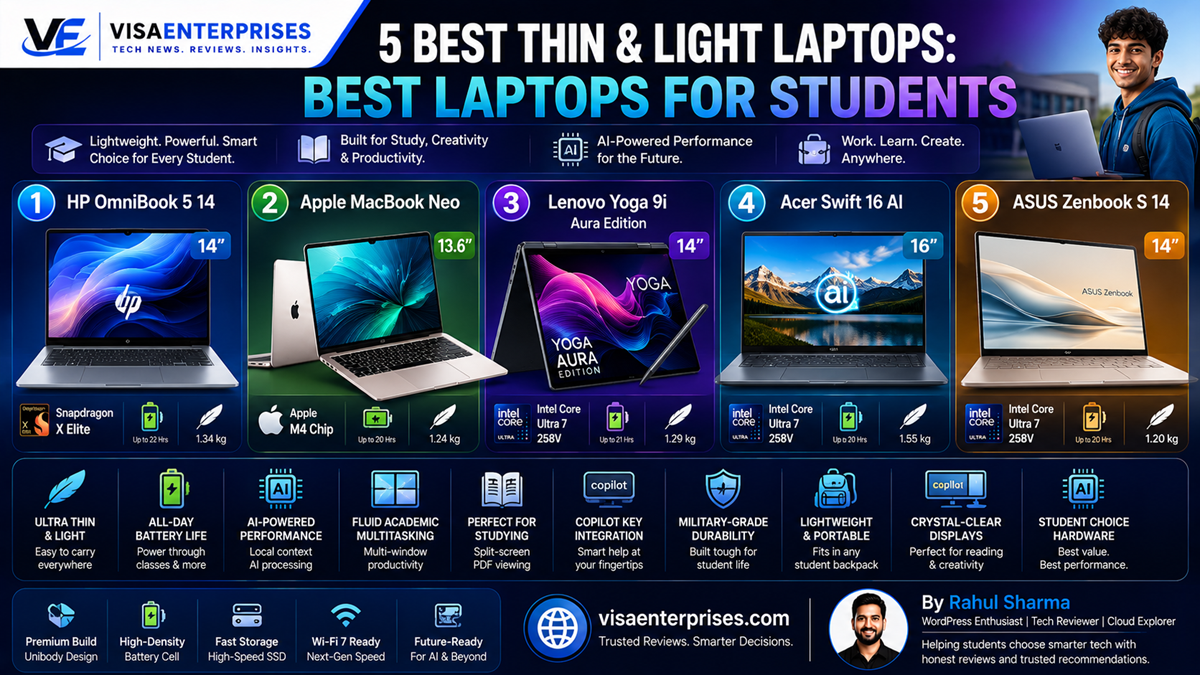
The best laptops for students and fast-moving professionals successfully balance a lightweight chassis, long battery life, and crisp, eye-friendly screens. For the absolute peak of campus endurance, the HP OmniBook 5 14 (Snapdragon) leads the Windows class by squeezing an astounding 34 hours of runtime out of its hyper-efficient ARM processor. For budget-conscious buyers, Apple’s new MacBook Neo offers a premium, unibody macOS experience at an unprecedented entry price. If you require maximum versatility for sketching or handwriting lecture notes, the Lenovo Yoga 9i Aura Edition stands out as the ultimate premium 2-in-1 convertible notebook.
Introduction
The annual search for the ideal academic workstation has shifted away from simply chasing raw clock speeds or finding massive internal hard drives. For a long time, selecting an affordable device for school meant carrying a heavy plastic brick that weighed down your backpack, suffered from washed-out display panels, and ran so hot that its loud fans would disrupt quiet lecture halls. Students were forced to choose between poor battery runtimes or spending thousands on pro-tier creative workstations.
That landscape has completely transformed. Today’s top thin-and-light ultrabooks run on highly optimized, intelligent chip architectures that deliver incredible power in incredibly slim unibody frames.
Whether your daily schedule involves writing long research papers, compiling complex programming projects, editing high-resolution media assets, or jumping across campus for back-to-back group meetings, finding a machine tailored to your exact workflow is completely achievable. This guide breaks down five outstanding options that earn their titles as the best laptops for students and mobile professionals.
Elite Campus Performers Evaluated
Finding the best laptops for students requires moving past basic spec checklists to look closely at real-world durability and classroom usability. A machine packed with high-end parts is of little use if its battery dies halfway through a morning seminar or if its fragile hinge cracks under the wear and tear of a daily commute. The best laptops for students on the market right now prioritize long operational battery life, sturdy metal unibody frames, and excellent typing comfort.
1. HP OmniBook 5 14: The Unrivaled Campus Battery King
HP has completely rewritten battery expectations for mobile student tech setups, making it a frontrunner among the best laptops for students. Driven by the energy-efficient Snapdragon X system architecture, the OmniBook 5 14 achieves an incredible, lab-tested 34 hours of continuous local video playback on a single charge.
The sleek aluminum chassis houses a beautiful, punchy OLED screen that presents rich color contrast ratios, ensuring your study slides and streaming media look exceptionally sharp.
2. Apple MacBook Neo: The Ultimate Accessible Mac
Apple has introduced its most compelling student option in years by creating a dedicated, value-first laptop line that ranks highly among the best laptops for students. The all-new MacBook Neo packs the efficient A18 Pro processing architecture into an elegant, fanless aluminum frame that remains completely silent during intense multi-window workloads.
By eliminating cooling fans, it removes moving parts that can wear down over time, providing students with a reliable macOS machine built to last through graduation.
3. Lenovo Yoga 9i Aura Edition: The Premium 2-in-1 Workhorse
For digital note-takers and architecture students who prefer a physical pen to a standard keyboard, Lenovo’s latest premium hybrid offers a top-tier experience. This device expands our selection of the best laptops for students by using a precise 360-degree soundbar hinge to fluidly transform from a standard laptop into a flat tablet canvas.
Powered by the latest Intel Core Ultra 7 258V chip, it includes an active stylus right in the box, making it a fantastic choice for sketching diagrams or highlighting research papers on the fly.
Technical Performance and Display Dynamics
Selecting from among the best laptops for students means tailoring your machine’s processing core to your specific field of study. Modern thin-and-light ultrabooks utilize advanced internal graphics layers and integrated Neural Processing Units (NPUs) to handle heavy math and local AI workloads effortlessly.
[Academic Coding/Writing Intent] ──> [Tensor/NPU Acceleration Core] ──> [LTPO/OLED Display Panel]
                                                                                   │
[All-Day Silent Productivity]     <── [Fast LPDDR5X System Memory]   <── [Low-Power Idle Standby]
Display Form Factors and Eye Comfort
When scanning lengthy digital textbooks or debugging lines of code late into the evening, screen quality impacts your focus directly. The best laptops for students shift away from narrow, legacy widescreen aspect ratios to modern 16:10 and 3:2 tall display shapes. This vertical space upgrade lets you see more lines of a text document or code file simultaneously, cutting down on constant scrolling.
Integrated Graphics and NPU Workloads
Under the hood, look for processors equipped with modern graphics blocks like Intel Arc or AMD Radeon units. These integrated components provide plenty of muscle to handle light video editing, 3D mapping, or machine learning algorithms without needing a heavy, battery-draining dedicated graphics card, ensuring these machines remain the best laptops for students across diverse academic majors.
Step-by-Step Optimization for Student Laptops
To ensure your academic laptop operates with peak responsiveness and delivers maximum runtime during long exam sessions, configure these essential system adjustments across your operating system.
1. Organize Local Application Synchronization Hubs
Prevent background data indexing from wasting processing power and draining your battery while jumping between lecture halls.
- Open your system Settings / System Preferences control center.
- Navigate into the Cloud Synchronization / OneDrive / iCloud folder options.
- Adjust your file properties to local download caching by selecting the Always Keep on This Device rule for your active course directories.
- Turn off continuous cloud background syncing during class hours to keep your system memory completely clear for active task multitasking.
2. Lock Down Display Luminance Scaling
Configure your screen brightness levels to automatically stretch your battery life when working away from standard wall outlets.
- Enter your system configuration application and click into Display / Screen Brightness.
- If you are working on any of the best laptops for students that feature an OLED display panel, switch your system theme over to Dark Mode natively across your browser and workspace applications to turn off dark pixels completely, saving valuable battery life.
3. Map Academic System Hotkeys and Shortcuts
Configure your built-in shortcut layout to quickly open split-screen views and launch your favorite research tools.
- On Windows 11 ultrabooks, press the physical Copilot Key or map
Win + Zto quickly dock app windows side-by-side. - Arrange your primary workspace to pin an automated note-taking app right next to your research browser tab.
- Configure your system to automatically disable non-essential notification banners during scheduled class blocks, keeping you entirely focused on your lectures.
4. Initialize Hardware Battery Saving Profiles
Activate protective power routing to extend the overall lifespan of your internal battery cell.
- Open your system Power and Battery Management dashboard.
- Turn on the Battery Charge Protection / Limit to 80% configuration setting if your laptop spends long hours plugged in at your dorm desk.
- This setting lowers thermal stress across the internal battery layers, keeping your cell healthy and ready for long study sessions on the go.
Common Campus Tech Mistakes to Avoid
Protecting your tech investment throughout your academic journey means avoiding a few common configuration and handling slip-ups, even when running the best laptops for students.
Selecting 8GB RAM Base Options for Advanced Majors
Choosing a restrictive 8GB memory configuration to shave a few dollars off your upfront costs can lead to system slowdowns if your major involves programming, data science, or media design. Running heavy developer suites, virtual machines, or multiple design layers simultaneously will quickly overwhelm an 8GB memory allocation. Always prioritize configuring a minimum of 16GB of high-speed system memory to keep your workflows future-proof.
Leaving Open Beverage Containers Right Next to Keyboards
Spilling liquids into a running ultrabook chassis remains the leading cause of accidental motherboard failures across college campuses. Because thin-and-light laptops position their main system components directly beneath the keyboard deck to save space, a single spilled cup of coffee can instantly short out the machine. Get into the habit of keeping water bottles closed and using secure, spill-resistant travel mugs on your study desk.
Blocking the Lower Heat Vents on Soft Surfaces
Using your laptop directly on soft beds, plush blankets, or fabric cushions can block the lower ventilation intake strips on your computer’s base casing. Forcing the system processor to run heavy compilation loops while resting on insulating fabrics traps heat inside, causing performance throttling and accelerating battery degradation. Always prop your machine up on a flat, solid desk surface or a hard binder when running intensive tasks.
Ultrabook Student Platform Comparison Table
The comparison matrix below highlights the key technical specifications and price points across the best laptops for students available right now.
| Premium Student Model | Physical Weight | Rated Battery Capacity | Primary Screen Panel | Installed Processor Core | Entry Price Point |
| HP OmniBook 5 14 | 1.32 kg / 2.91 lbs | Up to 34 Hours Total | 14.0-Inch 2.8K OLED | Snapdragon X Plus / Elite | ~$629 / ₹54,999 |
| Apple MacBook Neo | 1.24 kg / 2.73 lbs | Up to 16 Hours Natively | 13.0-Inch Liquid Retina | Apple A18 Pro Configuration | ~$599 / ₹49,990 |
| Lenovo Yoga 9i Aura | 1.35 kg / 2.98 lbs | Up to 23 Hours Total | 14.0-Inch 120Hz OLED | Intel Core Ultra 7 258V | ~$1,499 / ₹1,34,999 |
| Acer Swift 16 AI | 1.60 kg / 3.52 lbs | Up to 14 Hours Natively | 16.0-Inch 3K OLED Panel | AMD Ryzen AI 9 365 Engine | ~$899 / ₹84,644 |
| ASUS Zenbook S 14 | 1.20 kg / 2.64 lbs | Up to 20 Hours Total | 14.0-Inch 3K 120Hz OLED | Intel Core Ultra 5 226V | ~$1,199 / ₹1,05,990 |
Pros and Cons of Thin and Light Ultrabooks
Pros
- Effortless Portability: Super-slim unibody designs drop physical weight below 1.4 kg, making them incredibly easy to slip into standard backpacks.
- Exceptional Real-World Endurance: Efficient internal architectures let you leave bulky power bricks back at your dorm room for an entire day of classes.
- Stunning High-Contrast Screens: The transition to rich OLED and Liquid Retina display panels protects eye comfort during long study blocks.
- Whisper-Quiet System Thermals: Optimized fan control keeps your laptop running silently so it never creates a distraction during quiet exams.
Cons
- Limited Legacy Expansion Ports: The ultra-slim side panels usually cut out standard USB-A slots, making a small Type-C expansion hub necessary for older flash drives.
- Restricted Post-Purchase Upgrades: To keep dimensions as compact as possible, memory modules are soldered directly to the main system board, meaning components cannot be changed later.
Frequently Asked Questions
What features make an ultrabook one of the best laptops for students?
The top student options successfully combine a highly durable metal unibody chassis, a lightweight footprint under 1.4 kg, a long-lasting battery that clears 12 hours of real-world use, and a tall 16:10 or 3:2 screen to maximize reading space.
Is a Windows ultrabook or an Apple MacBook better for college?
Both paths are excellent but depend heavily on your specific coursework apps. Windows devices offer exceptional hardware versatility and native 2-in-1 touchscreen options, while MacBooks excel with rock-solid unibody build quality and optimized battery consistency.
Can a thin and light student laptop handle engineering software?
Yes. Modern thin ultrabooks running high-end processors like Intel Core Ultra or AMD Ryzen AI chips carry powerful integrated graphics architectures that can handle CAD software, software compilation loops, and data analysis tasks efficiently.
What is the advantage of choosing a Snapdragon-powered student laptop?
Snapdragon ARM processors operate with incredible energy efficiency. Laptops like the HP OmniBook 5 14 leverage this chip architecture to deliver an amazing 34 hours of battery life while staying completely cool and quiet.
Do these ultra-thin laptop frames include traditional headphone jacks?
Yes. Despite their incredibly slim profiles, almost all top-tier student ultrabooks continue to offer the standard 3.5mm analog audio port alongside modern high-speed USB-C connectivity slots.
How much internal storage capacity does an average student require?
While a 256GB drive can cover basic text files, a 512GB fast SSD is the ideal sweet spot for most college students. It provides plenty of local room to store large class presentations, media assets, and development libraries comfortably.
Can I run popular gaming titles on a thin and light student ultrabook?
They easily handle popular casual titles and esports games like Battlegrounds Mobile India (BGMI) or League of Legends at medium graphical settings. However, intense AAA titles require a dedicated gaming laptop with an active cooling fan stack.
What is the role of a built-in Copilot key on modern keyboards?
Following modern computing standards, the physical Copilot button gives you instant access to a helpful local AI assistant to summarize study notes, rephrase text blocks, or adjust laptop system tools with simple commands.
How can I protect my laptop display panel from getting scratched inside my bag?
Always invest in a padded protective travel sleeve before packing your computer into a full backpack, and verify that no hard objects like pens or cables are pressed directly against the outer laptop frame.
What wall brick is required to use fast charging features?
To take advantage of rapid charging speeds—recovering up to 50% of your battery life in roughly 30 minutes—pair your charging cable with a certified USB-C Power Delivery (PD 3.0) wall adapter rated for a minimum 65W output.
Final Verdict
Finding an exceptional option from among the best laptops for students no longer requires carrying a heavy, slow machine or compromising on battery life. By choosing a modern thin-and-light ultrabook that perfectly balances a bright, high-contrast screen with efficient processing power, you can tackle demanding academic projects with complete confidence.
For unmatched battery performance that frees you from the hunt for classroom wall outlets, choose the exceptional HP OmniBook 5 14. If you prefer a budget-friendly option with premium unibody build quality, Apple’s MacBook Neo is an incredibly value-packed choice. Whichever model lines up with your daily schedule, moving to a modern thin ultrabook gives you a spacious, high-performance digital workspace that will easily go the distance through your academic journey.
Technical Resources and References
Internal Links
For a deeper dive into our architectural components, view our related breakdowns:
External References
Review official review comparisons and technical device tracking logs directly from trusted industry chroniclers:
- PCWorld Best Laptop Picks: https://www.pcworld.com/article/436674/best-pc-laptops.html
- PCMag College Tech Rankings: https://www.pcmag.com/picks/the-best-laptops-for-college-students
- 91mobiles India Student Choice Portal: https://www.91mobiles.com/list-of-laptops/best-laptops-for-students

- 5 Smart Ecosystems: Best Smart Home Devices for Seamless Flow - June 2, 2026
- 10 Smart Choices: Top AI Productivity Tools for Workday Success - June 2, 2026
- 5 Smart Choices: Best Budget Smartwatch Models for Hitting Goals - June 2, 2026