
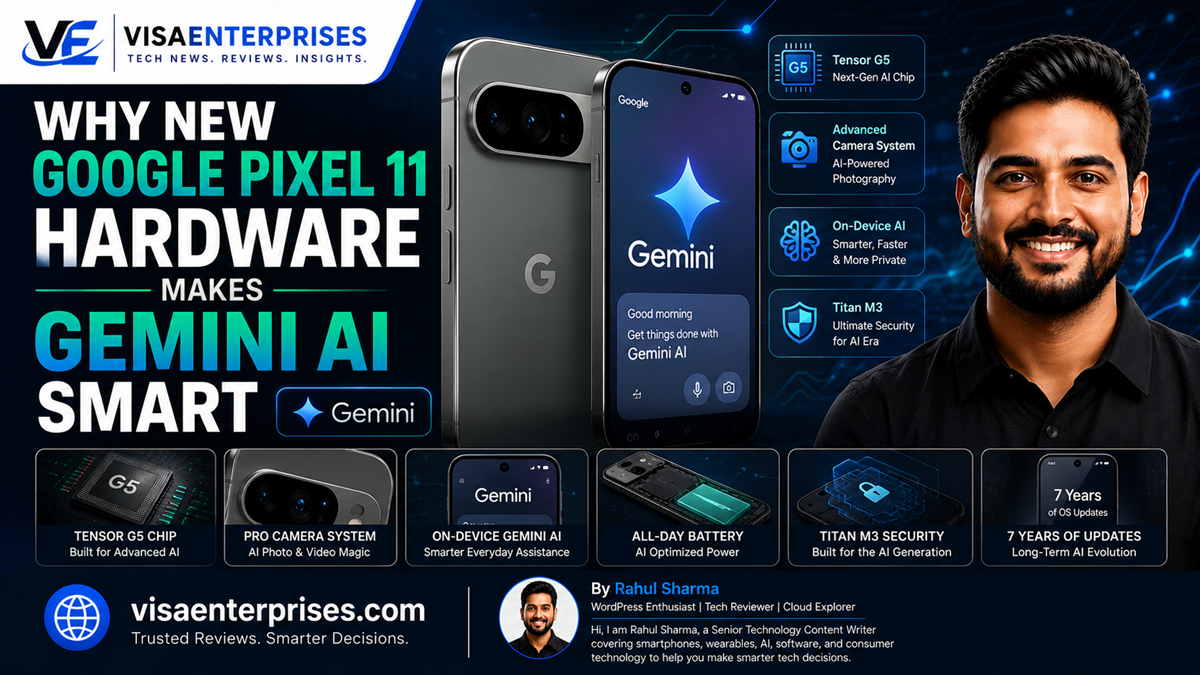
The comparison between the base Google Pixel 11 and the flagship Pixel 11 Pro XL highlights a major shift toward independent, on-device machine intelligence. While both phones leverage the next-generation Tensor G6 processor—built on TSMC’s advanced 2nm node—the Pixel 11 Pro XL gains a definitive edge for intense automation workflows. Equipped with 16GB of high-speed LPDDR5X RAM and an expanded thermal cooling layout, the Pro XL can run large multimodal models locally. The base Google Pixel 11, restricted to 12GB of RAM, relies on clever model compression and secure cloud processing to execute its day-to-day smart features.
Introduction
The premium smartphone industry is moving away from basic cloud-assisted features toward true on-device processing. Early iterations of mobile artificial intelligence operated like simple remote terminal windows; they required a continuous internet connection to send voice clips and text prompts up to external server farms for processing. This reliance on the cloud created noticeable response lag, raised data privacy concerns, and quickly drained device batteries.
The arrival of Google’s latest hardware lineup completely rewrites this architectural paradigm.
By analyzing the base Google Pixel 11 alongside the top-tier Pixel 11 Pro XL, this deep dive explores how structural hardware differences alter localized machine learning performance. From customized system chips and memory limits to advanced camera components, we analyze how these devices process next-generation software models under heavy daily use.
Next-Gen Tensor G6 and Dedicated TPU Architectures
At the center of both the Google Pixel 11 and the Pro XL is the custom-designed Tensor G6 platform. Moving away from the older fabrication styles of past generations, Google moved its silicon production to TSMC’s cutting-edge N2 (2nm) lithography node. This hardware migration yields massive improvements in energy efficiency and absolute processing speeds across the board.
[User Input Prompt] ──> [Tensor G6 ARM C1-Ultra Core] ──> [Custom 2nm On-Device TPU]
                                                                     │
[Finished Local Output] <── [Memory Allotment (12GB vs 16GB)] <── [Model Evaluation]
High-Performance Core Configurations
The underlying central processor features a robust seven-core arrangement optimized specifically for heavy multitasking and text-processing workflows. It links an ultra-high-speed ARM C1-Ultra prime core clocked at a blazing 4.11 GHz with four C1-Pro performance blocks running at 3.38 GHz, using two additional efficiency cores at 2.65 GHz to manage light baseline standby tasks.
By offloading repetitive vector math over to an upgraded, built-in Tensor Processing Unit (TPU), the chipset processes language requests up to 40% faster than previous models.
The Impact of Physical System Memory Allocation
While both variants share identical processing cores, their ability to execute complex, multi-layered operations depends heavily on their physical memory capacities:
- The Base Google Pixel 11: Ships with 12GB of LPDDR5X system memory, allocating a dedicated slice of hardware to keep a condensed version of Gemini Nano running constantly in the background.
- The Flagship Pixel 11 Pro XL: Bumps system memory up to a massive 16GB tier. This extra headroom allows the phone to load larger, uncompressed multimodal models directly into memory, letting you process real-time audio and high-resolution video streams locally without lag.
Local Thermal Management and Performance Stability
Running complex on-device generation cycles creates significant processing heat. To maintain stable performance numbers, the Pixel 11 Pro XL uses an enlarged internal vapor chamber cooling system. The base Google Pixel 11 relies on more compact thermal pads, which means it may occasionally throttle or hand off exceptionally large tasks to secure cloud relays during extended processing sessions.
Hardware Transformations and Camera Performance
Beyond the internal processor improvements, both devices introduce striking design changes and display upgrades. The classic rear camera strip gets a sleek refresh, shifting to an elegant all-black look that sits slimmer against the back panel. Additionally, Google added a unique “Pixel Glow” RGB LED notification array next to the lenses, which pulses custom color patterns to alert you to incoming messages when the phone is resting face down.
Bright, High-Refresh M16 OLED Displays
The screen layers receive a notable boost from advanced M16 OLED panels. The compact Google Pixel 11 carries a 6.3-inch display panel with a peak brightness of 3,000 nits. The larger Pixel 11 Pro XL steps up to a 6.8-inch LTPO display that supports a fluid 144Hz variable refresh rate and climbs to an impressive 3,300 nits, ensuring exceptional outdoor readability even in harsh midday sun.
Divergent Camera Array Capabilities
The physical size differences of the two models directly impact their camera setups and sensor configurations:
- Pixel 11 Dual Array: Uses a reliable 48MP main sensor alongside a 13MP ultra-wide lens, relying on smart machine-learning algorithms to deliver crisp 5x crop shots.
- Pro XL Triple Array: Features a powerful triple-sensor setup, including a 50MP primary lens, a 48MP ultra-wide camera, and a dedicated 48MP telephoto module with 5x true optical zoom that scales up to a 100x Super Res Zoom setting.
Step-by-Step Optimization for On-Device Intelligence
To maximize the processing speed and battery efficiency of your Google Pixel 11 hardware, configure these key system preferences within Android 17.
1. Optimize Local System Memory Allocations
Ensure your device prioritizes its hardware resources for local language modeling tasks.
- Open your core system Settings menu and navigate to System Options.
- Tap into the Developer Options row (if hidden, tap your Build Number seven times within the About Phone menu).
- Select Memory Optimization Settings and locate the AI Core Allotment slider.
- Adjust the profile to maximize the local cache, allowing Gemini Nano to remain resident in memory for instant responses.
2. Configure Custom Pixel Glow Alerts
Set up the rear RGB LED array to surface notification indicators without waking up the main screen.
- Navigate back to the main directory and tap into Display and Appearance.
- Select the Pixel Glow Notification configuration row.
- Turn on the tracking toggles for your primary communication and work applications.
- Assign distinct color signatures to your favorite contacts so you can filter alerts at a glance when the phone is face down.
3. Adjust Adaptive Screen Scaling Metrics
Balance the bright M16 OLED screen output with smart battery conservation.
- Enter the Display preferences and choose Smooth Display.
- Verify the option is active to allow the LTPO display to scale dynamically based on your content.
- Open the Brightness Optimization row and enable adaptive adjustment to prevent the high-nit display panel from draining power prematurely.
4. Enable Safe Offline Voice Processing
Set up your system tools to handle recording transcription and live translation tasks completely offline.
- Launch the core Settings app and select Google Assistant and Gemini Settings.
- Tap into the Offline Voice Models management profile.
- Download your specific localized language packs directly to the device’s storage.
- Toggle on Force Local Processing to ensure your audio recordings never leave the internal storage drive.
Common Hardware and Automation Pitfalls to Avoid
Getting the absolute best performance out of these advanced systems requires avoiding a few common configuration and charging errors.
Relying on Low-Wattage Legacy Power Bricks
The Pro XL model introduces faster 67W to 90W wired fast charging capabilities alongside Qi2 wireless charging support. If you stick with an older 15W or 30W charging brick from a legacy phone, your battery top-up times will slow down significantly. To experience rapid power recovery, pair your hardware with an official USB-C Power Delivery adapter that fully supports these higher wattage targets.
Disabling On-Device Processing to Save Battery
Turning off local processing toggles out of an overabundance of battery anxiety can backfire. Doing so forces basic translation, transcription, and photo editing tools to route data through external mobile networks. This cloud round-trip often consumes more total battery power than letting the highly efficient 2nm Tensor G6 chip handle the task locally.
Overlooking Local Storage Clearing Routines
Because advanced on-device tools store large translation dictionaries, speech files, and image adjustment caches locally, choosing a base 128GB storage tier can lead to space crunches over time. To prevent system slow-downs, regularly use the integrated storage management tools to clear out old temporary files and optimize your internal space.
Flagship AI Platform Specification Comparison
The table below highlights the key hardware variations between the base Google Pixel 11 and the premium Pro XL model.
| Hardware Feature | Base Google Pixel 11 | Flagship Pixel 11 Pro XL |
| Physical Screen Size | 6.3-Inch OLED Panel | 6.8-Inch LTPO OLED Screen |
| Max Screen Brightness | Up to 3,000 Nits | Up to 3,300 Nits Peak |
| Processor Platform | Google Tensor G6 (2nm TSMC) | Google Tensor G6 (2nm TSMC) |
| System Memory Tier | 12GB LPDDR5X RAM | 16GB LPDDR5X RAM |
| Primary Rear Cameras | Dual 48MP Wide & 13MP UW | Triple 50MP Main, 48MP UW, 48MP Tele |
| Optical Zoom Bounds | 5x Digital Sensor Crop | 5x Optical / 100x Super Res Zoom |
| Wired Power Intake | ~30W to 45W Fast Charging | 67W to 90W Rapid Power Delivery |
| Physical Chassis Armor | IP68 Dust & Water Shield | IP69 Enhanced Immersion Rating |
Pros and Cons of the New Pixel Series
Pros
- Superb 2nm Efficiency: The TSMC-built Tensor G6 runs complex tasks coolly while delivering excellent daily battery endurance.
- Instant Local Responses: The dedicated hardware TPU executes voice translation and text processing models with near-zero delay.
- Fun Notification Lighting: The rear Pixel Glow LED array offers a highly practical way to monitor incoming alerts when the device is face down.
- Stunning Outdoor Screens: The high-nit M16 OLED displays remain perfectly sharp and legible even under bright, direct sunlight.
Cons
- Base Model Memory Limitations: The 12GB memory cap on the base model means it must occasionally hand off large multimodal tasks to cloud servers.
- No Expandable Storage: The lack of a microSD slot makes choosing the right internal storage tier critical at checkout.
Frequently Asked Questions
What are the main differences between the Google Pixel 11 and the Pro XL?
The Pro XL features a larger 6.8-inch 1440p screen, 16GB of RAM for uncompressed local processing, a dedicated 5x optical telephoto lens, an IP69 rating, and faster wired charging speeds.
How does the Tensor G6 chip improve local performance?
Built on an advanced 2nm TSMC node, the Tensor G6 processor includes a custom TPU that runs language models up to 40% faster while drawing significantly less battery power.
What is the purpose of the Pixel Glow feature?
It is a small RGB LED notification array embedded into the rear camera bar that flashes custom color patterns to alert you to incoming notifications when the phone is face down.
Can the base Google Pixel 11 run all Gemini features offline?
The base model runs compressed versions of Gemini Nano smoothly, but tasks requiring massive multimodal processing may use secure cloud offloading due to its 12GB memory limit.
What are the battery capacities and charging speeds for these models?
The base model features a 4,840 mAh to 5,000 mAh battery with 45W charging, while the Pro XL upgrades to a 5,200 mAh to 5,500 mAh battery that supports up to 90W fast charging.
Does the camera bar design change on this latest generation?
Yes. The camera bar has been redesigned with a slimmer, all-black profile that blends neatly into the rear glass while housing the new Pixel Glow notification system.
How many software updates will these devices receive?
Google officially promises 7 full years of major Android operating system upgrades and consistent security patches for both models, ensuring support through Android 24.
Do these new models include built-in temperature sensors?
No. Google removed the infrared thermometer found on older models, replacing that space with the more practical Pixel Glow RGB LED notification layout.
Is the display glass well protected against drops and scratches?
Yes. Both devices use premium Corning Gorilla Glass Victus 2 panels over their bright M16 OLED screens to provide excellent protection against daily wear and tear.
Do these phones support the new Qi2 wireless charging standard?
Yes. Both models include built-in magnetic rings that fully support the Qi2 wireless charging standard, ensuring perfect alignment with modern magnetic docks and accessories.
Final Verdict
Evaluating the Google Pixel 11 alongside the Pro XL underscores Google’s clear commitment to building a hardware stack optimized for on-device machine learning. By moving production to a highly efficient 2nm TSMC node and embedding a custom, high-speed TPU into the silicon, both models deliver exceptional performance for daily tasks.
While the base Google Pixel 11 remains a fantastic option for users who prefer a compact design, power users and tech enthusiasts should opt for the Pixel 11 Pro XL. Its massive 16GB memory tier, advanced triple-camera array, and superior thermal design ensure you can run tomorrow’s complex multimodal applications locally without hitting a performance wall.
Technical Resources and References
Internal Links
For a deeper dive into our architectural components, view our related breakdowns:
- Amazing Benefits: Samsung Galaxy S26 Ultra Review and Guide
- iPhone 18 Leaks Point to a Smart Foldable Reveal
External References
Review official reports and technical chip breakdowns directly from trusted industry authorities:
- GSMArena Hardware Tracking: https://www.gsmarena.com/google_pixel_11_pixel_11_pro_pixel_11_pro_xl_pixel_11_pro_fold_specs_leak-news-72668.php
- PhoneArena Component Analysis: https://www.phonearena.com/google-pixel-11-pro-release-date-price-features-news
- Cashify System Specification Summary: https://www.cashify.in/google-pixel-11-pro-pro-xl-launch-date-price-and-specs

- 5 Smart Ecosystems: Best Smart Home Devices for Seamless Flow - June 2, 2026
- 10 Smart Choices: Top AI Productivity Tools for Workday Success - June 2, 2026
- 5 Smart Choices: Best Budget Smartwatch Models for Hitting Goals - June 2, 2026